Geometric Pattern Circle: A Practical Resource for Clean, Scalable Design
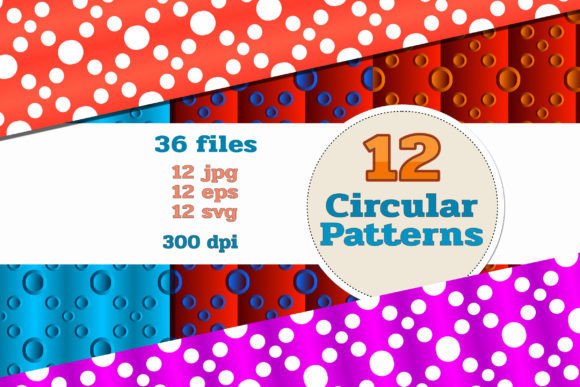
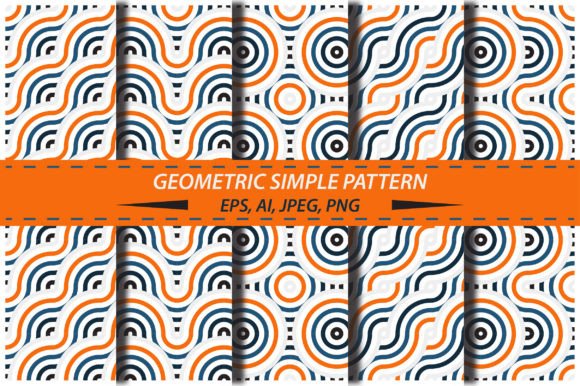
Geometric Pattern Circle is a focused collection of five minimalist geometry patterns built around the fundamental round shape. Unlike ornate or layered motifs, these designs rely on precise line work, balanced negative space, and consistent repetition—making them especially suited for applications where clarity, scalability, and visual restraint matter. They’re not decorative flourishes; they’re functional assets designed to integrate seamlessly into professional workflows across print, digital, and product contexts.
What Sets These Patterns Apart
The strength of Geometric Pattern Circle lies in its disciplined simplicity. Each pattern uses only lines—no gradients, textures, shadows, or complex fills—to construct variations of circular geometry: concentric rings, intersecting arcs, radial grids, offset loops, and segmented halos. This restraint ensures high legibility at any scale and predictable behavior across materials. Because the underlying structure is mathematically grounded—not hand-drawn or stylized—the patterns retain integrity when resized, repeated, or recolored.
Unlike generative or AI-produced patterns that sometimes suffer from inconsistent spacing or irregular node alignment, these were crafted with vector precision. The EPS and AI files (Illustrator 8 compatible) preserve editable paths, allowing designers to adjust stroke weight, spacing, or color without raster degradation. That level of control matters when adapting a motif for a book cover’s fine typography or a textile’s repeat tile.
Real-World Usability Across Mediums
In practice, Geometric Pattern Circle performs well where minimalism meets function. For wallpaper installation, the 12×12 inch (864×864 px) dimensions align cleanly with standard tiling workflows in design software—no manual cropping or scaling needed. The PNG files include transparent backgrounds, making them ideal for mockups: applying one of the patterns to a pillowcase or tote bag preview requires only a single layer blend mode, not masking or cleanup.
Print professionals will appreciate the inclusion of both JPEG and PNG formats. JPEGs provide fast, lightweight previews for client approvals or web galleries; PNGs preserve alpha channels for seamless integration into layered layouts. The vector files go further—they allow output at any physical size without pixelation, whether printing a 30-inch wall mural or embroidering a 2-inch motif onto a handkerchief hem.
One realistic example: a small-batch apparel brand used the segmented halo variation as a subtle all-over print on organic cotton tank tops. Because the pattern’s line weight remained crisp even at fabric-scale resolution—and because the spacing avoided visual clutter—it translated cleanly through screen printing without ink bleed or registration issues. Similarly, an educational publisher applied the concentric ring version as a chapter divider background in a STEM-focused workbook; its clean geometry reinforced thematic consistency without competing with diagrams or text.
Consistency and Reliability in Execution
All five designs share uniform technical specifications: identical canvas size, consistent DPI (300 for print-ready use), and harmonized line weights relative to overall scale. This consistency reduces decision fatigue during selection—there’s no need to audit each file individually for compatibility. It also supports brand systems where pattern families must coexist: pairing one variation for packaging and another for digital UI elements feels intentional, not arbitrary.
That said, limitations exist. Because these are strictly monoline patterns—no variable strokes, dashes, or textured edges—they won’t suit projects requiring tactile depth, vintage character, or illustrative warmth. They also assume users have baseline familiarity with vector editing tools; someone relying solely on Canva or basic photo editors may find the AI/EPS files less immediately usable without conversion steps.
Who Benefits Most—and When
Freelance designers building brand toolkits for startups often need scalable, royalty-free assets that reinforce modernity without sacrificing versatility. Geometric Pattern Circle fits that need directly: it offers ready-to-deploy motifs that communicate precision and calm—qualities aligned with tech, wellness, architecture, and academic sectors. A marketer launching a mindfulness app might use the radial grid as a subtle loading animation background; an interior designer specifying custom wallpaper for a boutique hotel lobby could apply the offset loops at large scale for quiet rhythm.
Educators developing classroom materials benefit from the clarity and neutrality of these patterns. Unlike busy or culturally loaded motifs, they provide visual framing without distraction—ideal for worksheets, presentation templates, or digital whiteboard resources. Small business owners ordering branded merchandise—especially those prioritizing sustainability—find value in patterns that print cleanly on natural fibers and recycled substrates, where heavy ink coverage or fine detail can compromise eco-goals.
For serious hobbyists—think quilters mapping pieced circles or ceramicists planning sgraffito layouts—the predictability of the vector paths allows direct import into cutting machines or CNC software. One user reported tracing the intersecting arcs into a laser-cut stencil for concrete garden pavers; the clean curves held up across material transitions from digital file to physical etch.
Integration Into Existing Workflows
No special plugins or proprietary software are required. The Illustrator 8 compatibility means broad backward support—even older studio machines or shared lab computers can open and edit the AI files. For teams using Figma or Sketch, the SVG export path (easily derived from EPS or AI) maintains fidelity and enables collaborative annotation. And because the JPEG and PNG variants are universally supported, non-design stakeholders—clients, printers, production managers—can review, approve, or prep files without licensing barriers.
A practical recommendation: start by testing one pattern at actual output size. Print a 4×4 inch swatch on your intended substrate (e.g., linen for pillowcases, matte paper for book covers) before committing to full runs. This reveals how line weight interacts with texture and absorbency—subtle but critical for final quality. Also, consider color contrast carefully: thin-line geometry relies on sufficient value difference between motif and background to remain legible, especially in ambient lighting or on curved surfaces like tote bags.
Long-Term Value and Iteration Potential
These aren’t trend-dependent assets. Minimalist geometry rooted in the circle has enduring relevance across design eras—from mid-century modernism to contemporary digital interfaces. That timelessness increases reusability: a pattern selected today for a website header can later serve as embossing foil on business cards or as a watermark on internal documents, without feeling dated or mismatched.
Because the source vectors are fully editable, iteration is straightforward. Need bolder lines for a billboard? Adjust the stroke in Illustrator. Want a duotone effect for a limited-edition poster? Apply two spot colors to separate path groups. Even minor tweaks—rotating one variation 15 degrees or nesting two patterns with reduced opacity—yield distinct outcomes without sourcing new assets.
If you work regularly with repeatable, scalable, and professionally structured design elements—and value consistency across mediums—Geometric Pattern Circle delivers measurable utility. It’s not a novelty item. It’s a quietly capable resource: precise where it needs to be, flexible where it counts, and built to last beyond the next project cycle.