Tropical Design Digital Papers: A Vibrant Resource for Creative Professionals and Makers
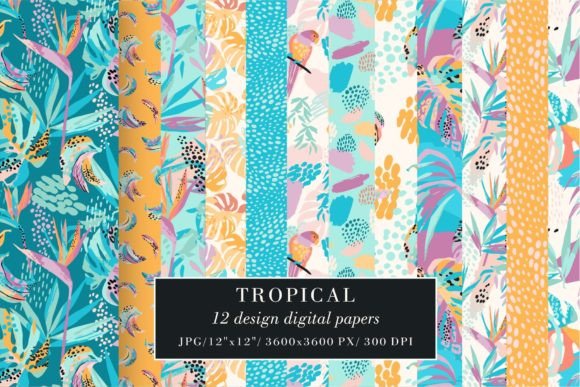
When color, rhythm, and organic form converge in digital format, the result is more than decoration—it’s a functional design asset. Tropical Design Digital Papers embody this convergence: a thoughtfully curated collection of 12 high-resolution digital patterns rooted in the exuberance of tropical ecosystems. These aren’t generic stock motifs. Each pattern draws from real-world botanical and avian references—parrots in mid-flight, unfurling banana leaves, asymmetrical fronds, and abstracted jungle textures—all rendered with intentionality and technical precision. The outcome is a versatile toolkit that bridges aesthetic appeal with production readiness.
Why Resolution and Format Matter in Real-World Applications
The technical foundation of Tropical Design Digital Papers sets them apart from casual downloads. Every file arrives as a JPEG at 300 DPI, sized precisely at 12 inches by 12 inches—or 3600 × 3600 pixels. This isn’t arbitrary. At 300 DPI, the files meet industry standards for professional printing across multiple substrates: cotton fabric for apparel, matte or glossy paper for stationery and packaging, non-woven wallpaper for interior installations, and even vinyl for signage or decals. Unlike lower-resolution web graphics that pixelate under magnification or scale poorly, these files retain crisp detail whether printed at business-card size or wall-spanning dimensions.
Consider a textile designer developing a summer capsule collection. Using a 72 DPI image would require upscaling—introducing blur, artifacts, and inconsistent line weight. With Tropical Design Digital Papers, the same file can be tiled seamlessly across a yard of fabric without interpolation loss. Similarly, a branding agency designing eco-conscious packaging for a cold-pressed juice line can apply a banana-leaf motif directly to a 10 × 7-inch box template, confident the leaf veins and subtle gradients will reproduce accurately on uncoated kraft board.
Patterns Grounded in Nature—Abstracted for Flexibility
The collection avoids literal illustration in favor of abstraction guided by natural logic. One pattern may isolate the silhouette of a scarlet macaw’s wing, then repeat it in staggered rhythm against a background of softened, watercolor-style banana stem cross-sections. Another interprets tropical foliage not as identifiable species, but as layered negative space—deep emerald shapes receding behind translucent lime overlays, evoking dappled light through a canopy. This approach ensures visual interest without overwhelming specificity: a parrot motif reads as joyful and tropical, yet doesn’t anchor the design to a single geographic region or conservation narrative unless intentionally layered by the user.
This abstraction also supports accessibility and cultural adaptability. A schoolteacher creating bilingual classroom posters can select a pattern with strong contrast between warm coral and cool teal—colors that maintain legibility for learners with color vision differences—while still conveying “tropical” through shape language rather than taxonomic accuracy. Likewise, a product designer prototyping reusable grocery bags can use a simplified palm-frond repeat that scales cleanly down to a 4-inch pocket print, where fine details like feather barbs or vein bifurcations would vanish.
Workflow Integration Across Disciplines
Tropical Design Digital Papers integrate smoothly into common creative pipelines—not as standalone images, but as modular components. In Adobe Photoshop or Affinity Photo, designers apply them as smart object fills or layer masks to control opacity, blending mode, and tiling behavior. In vector-based tools like Illustrator or InDesign, they’re placed as high-res raster links—preserving editability of surrounding text or layout while ensuring output fidelity.
- Fashion & Apparel: Surface designers import files directly into textile CAD software (e.g., NedGraphics or Kaledo) for repeat analysis, color separation, and weft-knit simulation. A repeating parrot motif works equally well on lightweight rayon challis or structured linen-cotton blends—the key is consistent DPI and neutral white balance, both maintained across the collection.
- Packaging & Branding: When developing shelf-ready mockups for a new line of tropical-flavored granola bars, designers use the banana-pattern variant as a base texture beneath die-cut window areas. The organic irregularity prevents the package from feeling sterile, while the 12×12 grid allows precise alignment with standard corrugated board grain directions.
- Interior & Spatial Design: For temporary installations—like a pop-up café themed around Costa Rican biodiversity—a designer might project one of the leaf-based patterns onto raw plywood walls using a calibrated projector. Because each file is square and resolution-matched to common projector native outputs (e.g., 3600×3600 approximates 4K UHD), scaling remains distortion-free without manual cropping or stretching.
- Educational Materials: A biology instructor building an interactive plant morphology module can extract individual leaf silhouettes from the JPEGs using quick-selection tools, then convert them to SVG for labeling exercises. The clean edges and intentional negative space simplify path tracing compared to photograph-based sources.
Practical Considerations for Ethical and Effective Use
While the visual energy of Tropical Design Digital Papers invites immediate application, thoughtful implementation requires attention to context. Bright, saturated palettes—like electric yellow paired with cobalt blue—carry high visual weight. That’s advantageous for attracting attention on social media thumbnails or retail displays, but may fatigue viewers in long-form print layouts such as exhibition panels or educational handouts. Strategic reduction—applying the pattern only to headers, borders, or icon backgrounds—maintains thematic resonance without compromising readability.
Color management is another quiet but critical factor. The files are delivered in sRGB, the standard for web and most commercial print workflows. However, designers preparing for Pantone-matched brand guidelines should treat the JPEGs as directional references—not final color specifications. A vibrant “tropical green” on screen may shift when translated to coated CMYK or spot ink; using the digital papers as mood-setters during early concept phases, then refining palettes in dedicated color libraries, yields more predictable outcomes.
Licensing clarity also supports responsible use. These are royalty-free digital papers intended for both personal and commercial projects—including client work—but not for resale as standalone digital assets (e.g., uploading to a design marketplace as your own pattern pack). This distinction matters for educators assigning student projects or small studios building brand identities for local businesses: users retain full creative control over how the patterns are adapted, layered, or combined with original illustrations or typography.
Beyond Decoration: Patterns as Narrative Anchors
In experiential design, patterns do more than fill space—they signal tone, origin, and values. A boutique hotel in Miami using a custom wallpaper installation derived from the parrot-and-leaf blend communicates vibrancy and regional connection without cliché. The abstraction allows guests to interpret the motif personally: some see playfulness, others see ecological richness, still others simply feel uplifted by the rhythm and saturation. That multiplicity is intentional—and rare in mass-produced design resources.
Similarly, a nonprofit focused on rainforest conservation might use a subtly desaturated version of the banana-stem pattern as a watermark across grant proposal PDFs. It functions as quiet reinforcement of mission—neither distracting nor didactic—while maintaining document professionalism. The same file, brightened and scaled large, becomes the backdrop for a fundraising gala invitation, proving one asset can serve divergent communication goals depending on treatment.
Expanding Creative Possibility Through Constraints
Twelve patterns may seem limited next to vast online marketplaces offering thousands. Yet constraint fosters cohesion. With Tropical Design Digital Papers, users aren’t choosing from endless options—they’re selecting from a harmonized system. All 12 share underlying color logic: no neon pinks clash with muddy olives; no pattern relies solely on fine linework that vanishes on coarse substrates. This internal consistency reduces decision fatigue and accelerates iteration. A surface designer exploring three fabric prototypes can confidently rotate among three complementary patterns—say, the bold parrot repeat, the rhythmic banana cluster, and the soft-focus monstera variation—knowing hue temperature, contrast ratio, and scale hierarchy have already been resolved at the source.
That harmony extends to physical output. Because every file shares identical dimensions and resolution, batch processing—whether applying color adjustments in Lightroom, prepping for DTG printing, or generating CSS background tiles for a responsive website—is uniform. There’s no need to resize, resample, or re-crop mid-project. Time saved here accumulates: hours reclaimed across dozens of micro-decisions compound into meaningful efficiency for educators building curriculum materials, entrepreneurs launching e-commerce stores, or makers fulfilling craft-fair orders.
In essence, Tropical Design Digital Papers offer more than visual flair. They deliver reliability, adaptability, and quiet sophistication—qualities that don’t shout, but sustain. Whether anchoring a global brand refresh or adding joy to a child’s handmade greeting card, their strength lies in how effortlessly they move between intention and execution, nature and abstraction, digital precision and tactile warmth.