Square Pattern - Super Collection
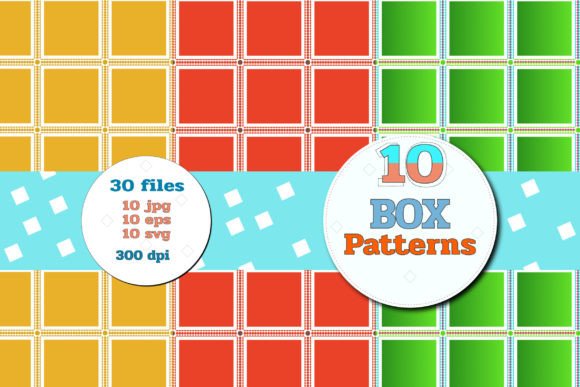
The Square Pattern - Super Collection is a curated digital asset package containing 10 distinct square-based repeating patterns, delivered in multiple industry-standard formats and high-resolution specifications. It includes 10 JPG files, 10 EPS files (compatible with Adobe Illustrator, CorelDRAW, and Affinity Designer), and 10 SVG files—all rendered at 300 DPI and sized at 2800 px × 2800 px in RGB color mode. The collection is designed for versatility across both physical and digital applications.
What This Collection Offers—and What It Doesn’t
Each pattern in the Square Pattern - Super Collection is built on a square tile structure, making it inherently suitable for seamless tiling in print layouts, web backgrounds, or surface design. The inclusion of JPG, EPS, and SVG ensures compatibility across raster-based editing (e.g., Photoshop), vector-based workflows (e.g., Illustrator), and scalable web use (e.g., CSS background images or inline SVG). The consistent 2800 px × 2800 px dimension and 300 DPI resolution support professional print output—including book covers, stationery, packaging, and wall decals—while remaining usable for high-fidelity screen display.
However, this is not a generative toolkit or editable pattern builder. Users receive fixed designs—not customizable templates or parametric assets. There are no layered PSD files, no source AI files with editable swatches or symbols, and no licensing for resale of the patterns as standalone products. The collection provides ready-to-use assets, not underlying design systems.
Who Might Benefit Most
This collection suits practitioners who need reliable, production-ready square patterns without investing time in creation or licensing negotiation. Graphic designers preparing client deliverables—such as custom notebook covers, branded merchandise, or presentation slide backgrounds—can integrate these patterns quickly. Print-on-demand creators may use them for greeting cards, fabric mockups, or planner inserts where consistent tiling and color fidelity matter. Web designers working on portfolio sites or small business landing pages can apply SVG or high-res JPGs as subtle, non-distracting background elements.
It also serves hobbyists engaged in decoupage, scrapbooking, or DIY home decor projects. Because each file is provided in multiple formats, users aren’t locked into one software ecosystem: someone using Affinity Designer can work natively with the EPS files, while a Canva user can import the JPGs directly. The uniform resolution and color profile reduce guesswork during preparation.
Key Considerations Before Choosing
First, assess your intended use case against the technical specifications. If you require CMYK color space for commercial offset printing, note that all files are RGB. While conversion is possible, color shifts may occur—especially in saturated blues and greens. Similarly, if your workflow depends on Pantone spot colors or requires embedded ICC profiles, this collection does not include those features.
Second, consider scalability needs. SVG files offer infinite scalability without quality loss, but only if used in contexts that support vector rendering (e.g., modern browsers, vector editors). For large-format prints like murals or banners exceeding 36 inches, the 2800 px dimension may require interpolation—though 300 DPI at that size remains acceptable for typical viewing distances.
Third, evaluate licensing scope. The collection permits use in both personal and commercial projects—including client work—but prohibits redistribution of the patterns themselves (e.g., selling them as part of a “pattern bundle” on Creative Market). If your project involves white-labeling or embedding patterns into software or SaaS tools, verify whether the license covers such use.
When Alternatives May Be More Appropriate
If your work demands highly specific stylistic control—such as adjusting line weight, spacing, or color harmony across multiple patterns—a custom commission or a parametric tool (like Adobe Substance Designer or dedicated pattern generators) may offer greater flexibility. Similarly, designers building long-term brand systems may prefer developing original patterns to ensure uniqueness and full intellectual property control.
For users needing broader variety—such as organic motifs, diagonal repeats, or asymmetric layouts—larger marketplace subscriptions (e.g., Creative Market bundles or Envato Elements) provide access to hundreds of patterns across categories, often with extended licenses and regular updates. These services trade upfront cost for breadth and ongoing access, whereas the Square Pattern - Super Collection offers finite, focused utility.
Finally, educators or students exploring pattern theory may find value in open educational resources or academic pattern libraries that include technical documentation—tile construction diagrams, symmetry group labels (e.g., p4m, p4g), or historical context. This collection prioritizes practical application over pedagogical depth.
Making a Practical Decision
Ask yourself three questions:
- Do I need exactly ten high-quality, tileable square patterns—no more, no less—with immediate usability across print and digital? If yes, the consistency and format coverage of this collection simplify implementation.
- Is my workflow constrained by software compatibility or output requirements? Review whether EPS support matters for your vector editor, or whether SVG integration fits your web stack. If you rely heavily on Procreate or Figma, JPG imports will suffice—but you’ll miss out on vector precision.
- Does my project timeline favor speed over customization? When deadlines are tight and visual cohesion is essential, sourcing tested, resolution-appropriate assets reduces iteration cycles compared to designing from scratch or filtering through inconsistent free resources.
Conversely, if you anticipate needing variations—light/dark versions, alternate colorways, or responsive variants for different screen sizes—this static collection won’t adapt. In those cases, building a modular system or selecting a service with versioning support becomes more sustainable.
Final Perspective
The Square Pattern - Super Collection occupies a practical middle ground: more capable than single-pattern downloads, less expansive than subscription libraries. Its value lies in predictability—consistent dimensions, format parity, and color handling—rather than novelty or scale. It supports execution, not exploration. For users whose goals center on reliable, efficient implementation across common creative tasks, it delivers measurable utility. For those whose priorities emphasize experimentation, deep customization, or long-term asset expansion, evaluating complementary or alternative resources remains advisable.