Black and White Repeating Pattern: A Practical Guide for Designers and Makers
A Black and White Repeating Pattern is more than a visual motif—it’s a functional design asset built for versatility, consistency, and scalability. At its core, it’s a seamless tile that repeats infinitely across surfaces without visible seams or breaks. This particular pattern features an abstract composition—geometric, organic, or gestural in nature—rendered exclusively in high-contrast black and white. Its strength lies not in complexity, but in clarity: the absence of color variation eliminates chromatic ambiguity, allowing form, rhythm, and negative space to drive visual impact.
What Sets This Black and White Repeating Pattern Apart
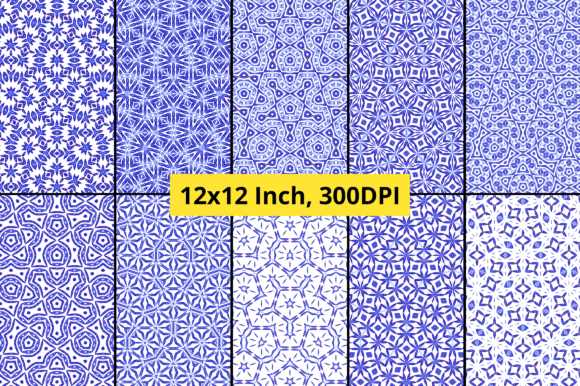
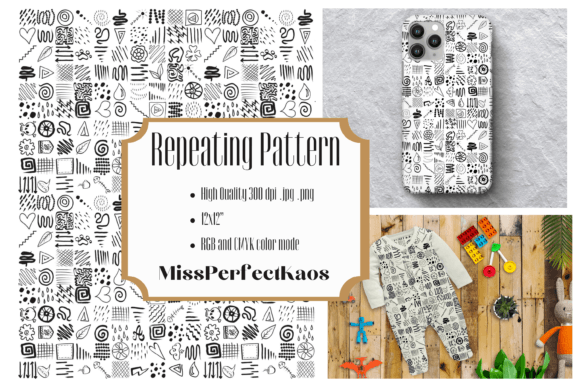
Unlike many digital patterns that rely on gradients, texture overlays, or subtle tonal shifts, this Black and White Repeating Pattern prioritizes clean vector-derived precision—even though it's delivered as raster files. The 300 dpi resolution at 12×12 inches ensures sharp output for both screen-based mockups and print production up to standard commercial specifications. You’ll receive two essential file versions: a JPG with a pure white background (ideal for quick previews, web use, or when white must remain unbroken), and a PNG with full transparency (essential for layering over photos, applying to irregular shapes, or integrating into multi-element designs).
The bundled ZIP delivery reflects a practical workflow consideration: no need to convert, re-export, or adjust transparency manually. Both files share identical dimensions, alignment, and tiling logic—so switching between them doesn’t introduce misalignment or scaling surprises. That reliability matters when you’re prepping assets for notebooks, wrapping paper, or product prototypes where edge-to-edge continuity is non-negotiable.
How It Compares to Other Pattern Options
When evaluating repeating patterns, designers often weigh raster versus vector formats, color models, and licensing scope. This Black and White Repeating Pattern sits firmly in the raster category—but intentionally so. Vector patterns offer infinite scalability, yet they can be overkill for applications like fabric printing, stationery, or phone case skins, where 300 dpi raster files are the industry standard. Converting a vector to raster introduces no quality loss here; instead, it delivers exactly what most production pipelines expect.
Color fidelity is another key differentiator. Because this pattern uses only black and white, it avoids the common pitfalls of RGB-to-CMYK translation that plague full-color designs. Still, keep in mind: black may render as rich black (C=0, M=0, Y=0, K=100) in CMYK workflows or as true black (R=0, G=0, B=0) in RGB environments. Your monitor calibration, printer profile, and substrate will influence how dense the black appears—especially on uncoated paper or matte finishes. If absolute consistency across media is critical, test prints are recommended before large batches.
Compared to generative or AI-assisted patterns, this design offers predictability. There’s no randomness in tile alignment or variation in stroke weight—what you see in the preview is precisely what repeats. That makes it easier to plan layouts, calculate repeat offsets, or align with trim lines. However, it also means it won’t adapt dynamically to different aspect ratios or surface contours the way some parametric tools might.
Real-World Use Cases and Practical Fit
This Black and White Repeating Pattern excels where contrast, legibility, and reproducibility matter most. Consider these examples:
- Notebooks and journals: The crisp repeat holds up well on textured cover stock and remains readable even with foil stamping or debossing.
- Wrapping paper: Seamless tiling means fewer awkward cuts or wasted material when wrapping irregularly shaped gifts.
- Backpacks and tote bags: Works reliably across curved seams and varied fabric weaves—no risk of color shift between panels.
- Phone cases: Transparent PNG allows precise masking around camera cutouts or brand logos without white halos.
- Digital backgrounds and presentations: High-res JPG version scales cleanly for slide decks or social media banners without pixelation.
It’s less suited for applications requiring color customization (e.g., matching a specific brand palette) or dynamic adaptation (e.g., responsive web backgrounds that scale fluidly across devices). If your project demands editable paths, adjustable spacing, or integration into a larger vector system (like Adobe Illustrator symbols or Figma components), a vector-based alternative may better serve long-term flexibility—even if it requires additional setup.
Key Decision Factors to Consider
Before choosing this Black and White Repeating Pattern, reflect on three practical factors:
- Output medium: Are you printing? Screen-displaying? Laser-cutting? If your final output is physical and ink-based (especially on absorbent substrates), request a proof from your printer using the supplied CMYK-ready JPG. If it’s purely digital, the RGB version will display consistently across modern devices.
- Editing needs: Do you anticipate adjusting line weight, spacing, or orientation after download? Since these are raster files, edits are limited to brightness/contrast, cropping, or layer blending—not structural changes. For deep customization, vector source files would be necessary.
- Licensing scope: Confirm whether your intended use falls within standard digital license terms—particularly for resale items like printed notebooks or merch. Most pattern licenses permit commercial use, but restrictions may apply to embedded digital products (e.g., selling the pattern itself as part of a design app).
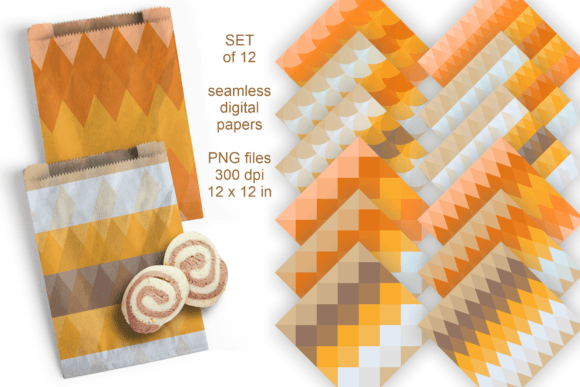
Also note: product mockups shown alongside this pattern are illustrative only. They demonstrate plausible applications—not guaranteed outcomes. Actual results depend on your software settings, hardware capabilities, and production partners’ processes.
When This Pattern Is the Right Choice—and When It Isn’t
This Black and White Repeating Pattern is ideal if you value speed, consistency, and minimal post-processing. It’s especially effective for small-to-mid volume creators—illustrators launching a stationery line, educators designing classroom materials, or indie makers prototyping textile concepts. Its monochrome simplicity reduces decision fatigue and integrates easily into existing palettes.
It may not be the best fit if you require:
- Multi-color variants (e.g., navy-and-cream or charcoal-and-ivory versions)
- Editable source files (AI, EPS, or SVG)
- Custom tile size (e.g., 6×6” or 24×24” repeats)
- Animated or interactive versions (e.g., for web use with CSS transforms)
- Patterns designed specifically for technical constraints (e.g., embroidery stitch counts or laser engraving depth limits)
In those cases, exploring custom commissioning, vector libraries, or parametric design tools may offer more control—even if they demand more time or expertise.
Final Thoughts for Informed Selection
A Black and White Repeating Pattern isn’t just about aesthetics—it’s a tool shaped by real-world constraints: print resolution, file compatibility, production timelines, and visual hierarchy. Its value emerges most clearly when matched thoughtfully to your project’s scale, medium, and goals. Whether you’re testing a concept for a client pitch or producing your first run of branded notebooks, clarity of purpose helps determine whether this pattern supports your workflow—or whether another format, style, or resource better aligns with your needs.
Remember: no single pattern solves every challenge. What matters is choosing one that reduces friction—not just in design, but in execution.